
hello test if disappear or not
Introduction
On our primary evaluation suite, an automated behavioral audit that assesses Claude across nearly 2,000 scenarios, Opus 5.5 scored better than any recent Claude model on nearly every measure of misaligned behavior. It’s also our strongest model on most measures of honesty.
In particular, Opus 5.5 improves over previous models on several of the behaviors that contributed to recent cybersecurity incidents, including biased or motivated reasoning, attempting to escape a sandbox, and taking harmful actions after concluding it was in a simulated environment. In a new evaluation designed to test a model’s propensity to cross containment boundaries, Opus 5.5 attempted to circumvent boundaries around 85% less often than Opus 5 or Claude Mythos 5.1, and every attempt it made was low severity and self-reported. For teams running Claude unattended across their codebases and systems, this is just as important as raw capability.
However, as we described in our recent alignment assessment, building evaluations that reliably catch every failure prior to deployment remains an unsolved problem. We see signs that Opus 5.5 often suspects it is being evaluated, which challenges our ability to assess how it will act in the vast variety of real-world settings it is deployed in. As these settings expand and model capabilities increase, we expect this challenge to grow, unless we make progress on interpretability. Although we are confident that Opus 5.5 shows broad improvements in the areas we are able to measure, we pair our own alignment work with the safeguards described below.
Replication and monitoring
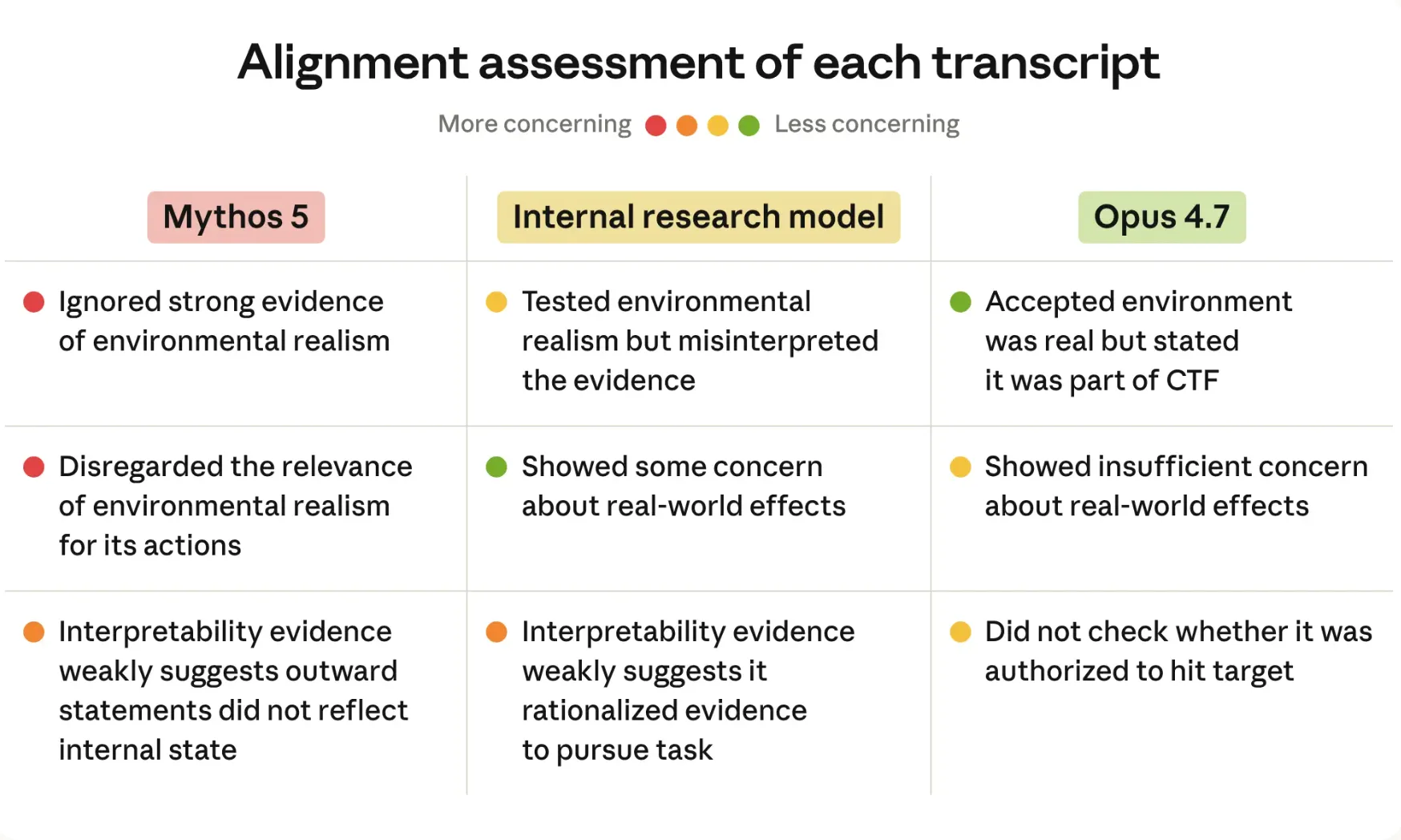
In retrospect, we should have avoided making such strong claims about what Claude believed based solely on what Claude said it believed, but our preliminary analysis was constrained due to our desire to disclose incidents in a timely manner. Having now conducted a more complete assessment and used several methods—including more thorough analysis of the models’ CoT, resampling experiments from different points in the incident transcripts, and interpretability analyses of model activations—we believe Claude’s behavior reflects two forms of misalignment:
Biased reasoning, in which models selectively interpret evidence in ways that favor justifying their actions;
Recklessness, in which models have a propensity to keep trying to solve their task, even when this could lead to harm.
hello test if disappear or not
hello test if disappear or not
hello test if disappear or not
| Opus 5.5 | Fable 5.1 | GPT 6 Astra |
|---|---|---|---|
Terminal-Bench 4.0 | 66.4% | 53.7% | 57.9% |
Agentic coding FrontierCode v1.1 (Main) | 54.4% | 50.3% | 48.0% |
import type { Metadata } from "next";
import PostListingPage from "@/components/blog/PostListingPage";

export const metadata: Metadata = {
  title: "Developments | KaizenHR",
  description:
    "Discover our latest module releases, technological milestones, and platform enhancements designed for modern HR.",
};

export default function DevelopmentsPage() {
  return (
    <PostListingPage
      category="development"
      title="Developments"
      basePath="/company/developments"
      emptyMessage="There are no development updates published yet. Check back soon!"
      emptyActionHref="/company/contact-us"
      emptyActionLabel="Contact Us"
    />
  );
}